

Para sa aking mga kapwa Pinoy: Step up. Show up.
The breakfast that started this
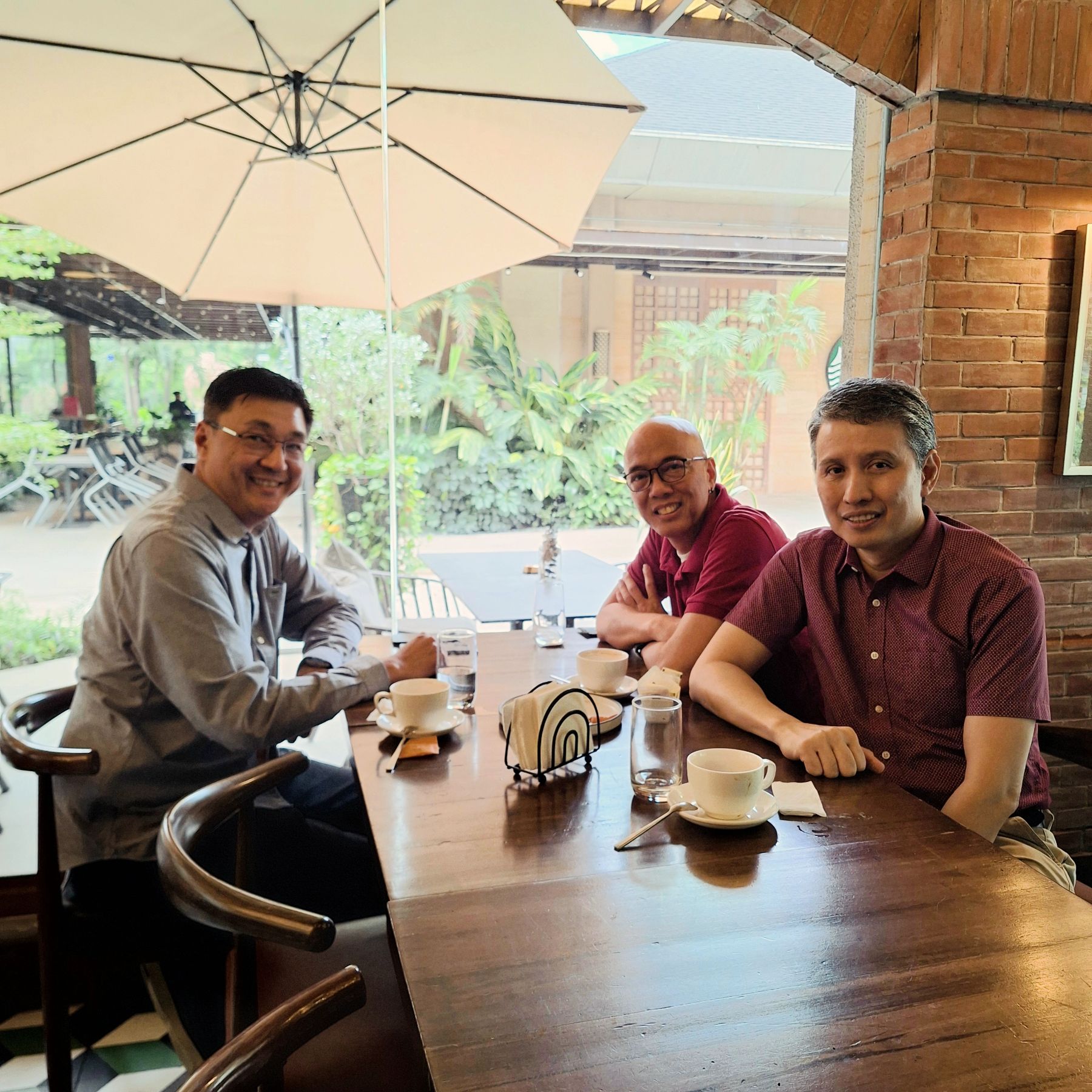
I was in Manila in February, sitting down for breakfast with two businessmen I’d never met before. One of them, Rufi Parpan, posted a photo of the three of us afterward. His caption was simple: Show up. Step up. The opportunities are there. It’s really on us.
That message stuck with me because I see it playing out everywhere I look.
I see it in the Filipino software engineers I’ve spoken with, sharp, talented people doing incredible work. I see it in the craftsmanship of Filipino artisans and designers. The talent is undeniably there.
And yet, when I look at opportunity meeting readiness, something shifts. There’s a gap between capability and action, and that gap is costing people more than they realize.
What I’m observing
Let me be direct about what I’m observing.
When I’m hiring for my company, I reach out to roughly twenty candidates at a time. And here’s why it takes that many. About half respond. Of those who respond, I schedule interviews with them. Only half of those confirm. And from that group, some don’t show up or cancel last minute.
Ba’t ka nag-apply kung ‘di ka naman sisipot?
Each time someone doesn’t follow through, a door closes, not just for that one moment, but for every conversation that could have happened after, every introduction they might have made, every opportunity that could have come from that relationship.
And this pattern doesn’t only show up in hiring.
As part of operating the business in the Philippines, I need to build relationships and establish partnerships with vendors. So I reach out through their websites, send emails, make calls, leave voicemails, and connect on LinkedIn. Quite frequently, nothing. No response. Not even a courtesy message saying they’re busy and will get back to me next week.
Parang ako pa ang kailangang manligaw.
What makes this stand out to me is the contrast. In my experience, the U.S. often operates on the opposite side of the spectrum, which is not necessarily healthy either. Even a small signal of interest can turn into daily calls, text messages, mailers, and nonstop follow-up. Neither extreme is ideal. But silence is the one that closes the door.
That’s not laziness. These companies are active. They’re operating. But there’s a disconnect between someone reaching out and someone deciding that reaching back matters.
And yes, I know this goes both ways. Recruiters ghost candidates. Clients ghost vendors. The erosion is mutual. But I can only speak from where I’m sitting.
And that’s what stays with me: not a lack of talent, but a lack of follow-through.
An introvert’s lesson
Part of why this hits me so personally is because I know what hesitation feels like.
Here’s what I want you to know: I’m an introvert. I’ve always been one. As a kid, I was a computer nerd, and I still am.
Being introverted doesn’t disqualify you from stepping through doors. In fact, over twenty-five years of engineering leadership, I’ve learned that showing up, literally and figuratively, is what creates momentum.
Not every door leads to success. But if you step through enough doors, if you respond to enough opportunities, if you show up when you commit to showing up, you will find your path.
If you don’t step through any, you won’t get that chance.
What showing up actually looks like
And that’s really what I’ve learned over time: showing up is not an abstract idea. It reveals itself in small, concrete actions, in whether you respond, follow through, and put yourself forward when the opportunity is there.
Showing up means different things depending on where you are.
If you’re meeting with someone, honor that commitment. Whether it’s a job interview, a business meeting, or an introductory conversation, respond, confirm, and be there at the agreed time. These are opportunities where someone has made time for you.
If you’re a vendor or service provider, it means getting back to someone who’s reaching out to you, even if it’s just to say you’re busy and will follow up next week.
If you’re in a role right now, don’t think that’s your ceiling. Look ahead. What’s the next position, the next challenge, the next opportunity for growth? Seek it. Apply for it. Talk to people about it.
I’ve seen Filipino leaders encourage their team members to apply for stretch roles or promotions, and the response is often: ‘Di pa ako ready. ‘Di ko kaya yan.
But that’s self-limiting before you’ve even tried.
When you strive, opportunities emerge, sometimes from places you didn’t expect. And when they do come, don’t reject them because you think you’re not ready. You won’t know if you’re ready until you try.
Even if you don’t land that role, you’ll learn what’s required. You’ll see what’s possible.
You’ll expand your own sense of what you’re capable of. That’s the real growth.
None of this is glamorous. It’s just consistent action.
The Lacoste shirt
But there’s another part to this that matters too.
Sometimes the problem isn’t just that people don’t show up. Sometimes it’s that they aim too low.
I was just out of college in the Philippines when I walked past a Lacoste store and saw a shirt, you know, the one with the crocodile logo. It cost three thousand pesos, roughly a hundred dollars during that time. At my first job, I was earning closer to three thousand five hundred pesos a month in take-home pay, so that shirt was nearly a full month’s salary.
And I made it my goal to buy that shirt.
At the time, it felt like a lifetime ambition. Now I see it for what it was: a self-imposed ceiling.
I was thinking in milestones when I should have been thinking in horizons. That shirt was never meant to be my destination, it was just a checkpoint on the way to somewhere bigger.
The problem is, I’ve seen this happen more often than I’d like. People reach the goal they set, and then start to think that’s it. That’s as far as you can go. That becomes the ceiling.
The cycle that holds us back
The system often reinforces that ceiling, even when someone is trying to step up. Sometimes you get rejected. Sometimes just getting there costs more than you have: three hours in traffic to an interview that didn’t happen, pamasahe you can’t get back, a day of side-income you had to give up. Sometimes the support you need never comes. Sometimes people tell you not to waste your time, or that it’s too risky. And sometimes the barriers are more cultural than formal: palakasan, hiya, or the fear of being seen as mayabang just for putting yourself forward.
And the trying itself is expensive: in time, in money, in the energy you have left after the day you’ve already had.
After enough of that, it becomes easy to believe the effort is not worth it.
And when the next opportunity comes, that discouragement starts to feel justified: this is too hard, the system won’t let me through, why bother? Why risk the good thing I already have?
One bad experience becomes the reason to stop trying. And then that becomes your reality. You don’t step through because you’ve already decided you can’t.
The system wins because you’ve done its job for it.
Speak up when the system fails you
But don’t let that be you.
When you hit barriers, and you will, that’s when stepping up takes on another meaning. Speak up.
If the system is making it harder for you to act, if bureaucracy or outdated processes are slowing you down, don’t just accept it. Make noise. Push for change.
But don’t let one closed door convince you that all doors are closed.
Because the talent is there. The opportunity is there. What’s missing sometimes is the visibility, the access, the removal of unnecessary friction.
And sometimes what’s missing is your willingness to try again.
Eto promise ko sa inyo
53 na po ako. I’m committing the rest of my professional life to building pathways for Filipino talent starting in software engineering, industrial design, and artisan crafts.
These are fields where I’ve seen Filipino capability firsthand, but where visibility and access are still not where they need to be. I’m focusing my efforts here because that’s where I see the opportunity to make a real difference.
I’m opening doors. But I can’t do this alone.
I’m asking Filipino-Americans and Filipinos abroad, wherever you are: help me create these opportunities. We have the knowledge, the networks, the resources. We have a responsibility to the next generation coming up behind us.
Hindi natin dapat sarilihin o hangarin na malamangan ang ating kapwa Pinoy.
Let’s not be the gate we had to push through.
Rufi was right.
The opportunities are there. It’s on us.
Show up. Step up.
I’m opening the door.
I’m asking others to do the same.
Now step through it.