

The $400 compiler
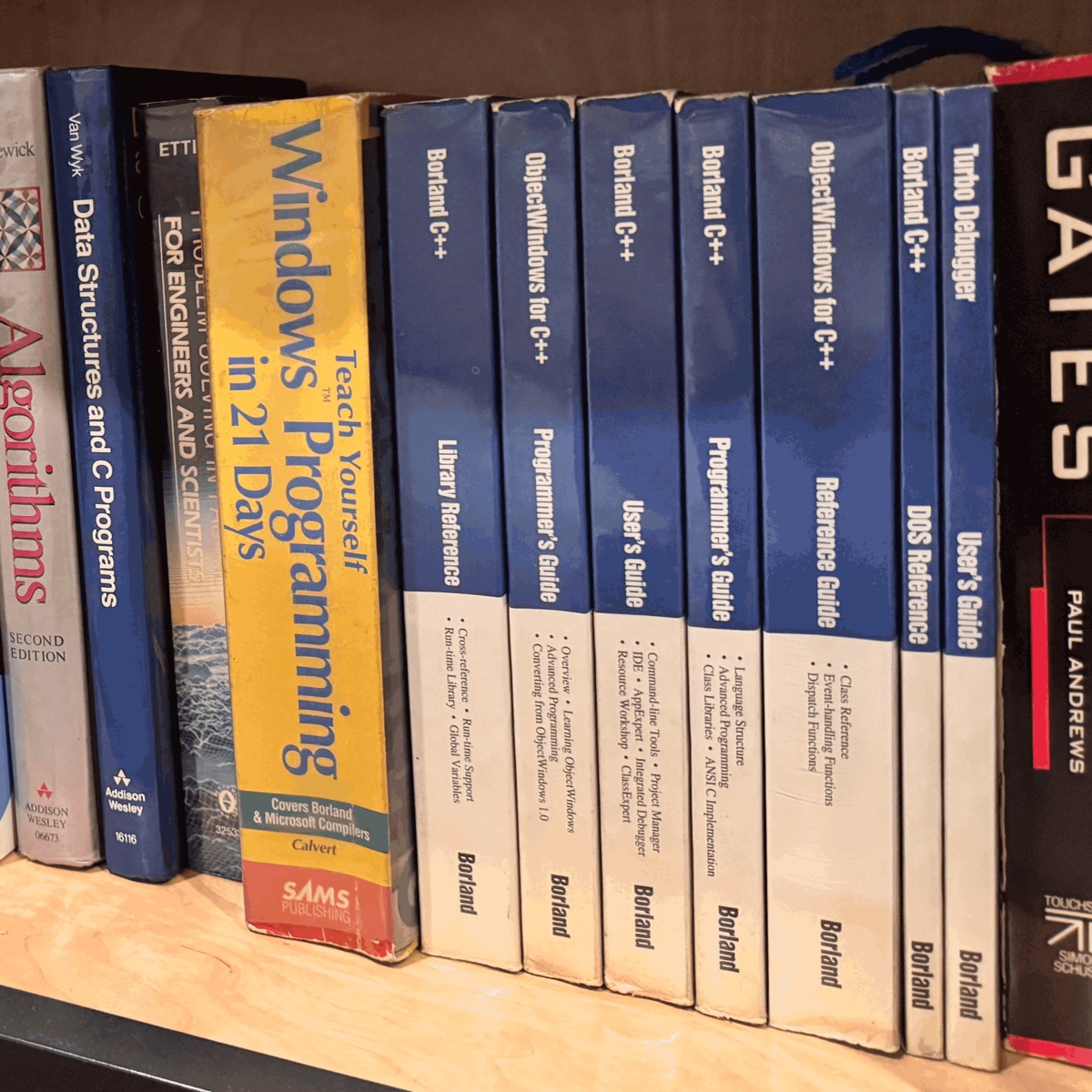
These are some of my books. A few of them are older than a good portion of the people who will read this. Programming languages, data structures, design, architecture. Looking at them is a fairly accurate picture of where I’ve spent most of my time over the last 30 years.
In the mid-90s, I was still in college, and I borrowed $400 from my parents so I could buy Borland C++ 4. I told them the purchase would pay for itself ten times over.
For a long time, that’s how I told the story. The software and these books paid for themselves many times over, likely more than a thousand times beyond what I estimated.
Today, they mean something different to me. They’re more a reminder that much of what I spent those 30 years learning may no longer be that useful.
That isn’t an easy thing to admit. I don’t mean the thinking behind those books has stopped mattering. I mean that a lot of the specific knowledge, the syntax, the APIs, the patterns I worked hard to memorize, the ability to write a lot of correct code quickly, is no longer what sets an engineer apart. An AI can now produce much of it in seconds.
Not the internet. The PC.
Over the past 12 months, I’ve come to a lot of realizations. One of the biggest is that AI is different from the disruptive technologies I’ve lived through before, including the internet, mobile, and cloud.
Yesterday I spoke with a senior engineer at an aerospace company. He said people keep comparing AI to the internet, but he believes it’s closer to the PC.
That framing has stayed with me. The internet, mobile, and cloud changed where software runs and how it reaches people. They created a huge amount of new work for engineers, but the work itself still looked familiar. We learned new platforms and new frameworks, then sat down and wrote the code. The books on my shelf kept being useful.
The PC was a different kind of change. Software engineers existed before it, on mainframes and in research labs, but it was a small specialist field. The PC is what made programming a thing. Millions of people learned to code, me included, and “software engineer” became a household name.
Borland C++ was a PC product. Part of the reason my $400 paid off is that the PC put a real compiler in the hands of a college student.
AI has a similar history. It has been around far longer than GPT-3, the same way software was around long before the PC. What’s new is that it has reached everyone. And like the PC, it’s changing the job itself, not just where software runs. AI is taking over the coding.
What the role becomes
If at least half of the job I used to do has changed, what comes next? And are we still software engineers?
I think so. For most of our careers, we were both the civil engineer and the construction worker. We designed the thing, and then we built it ourselves, line by line. Now we’re mostly the civil engineer. I don’t think anyone has the full picture of that job yet, me included, but here’s where I’ve landed for now.
When writing code is something we no longer have to do, the value moves toward deciding what should be built and being able to tell whether it’s right. Understanding a problem well enough to describe it clearly. Knowing which tradeoffs matter for this business, this customer, this system. Reviewing work you didn’t write and noticing where it’s quietly wrong. Owning the result once it ships.
That’s where some of the books still earn their place. I may rarely need to implement a data structure by hand again. But knowing why it exists, and when a simpler one would do, is exactly the judgment you need when an AI hands you a few hundred lines and says it’s done.
What I think is fading is the idea that an engineer’s worth is measured by how much code they can write or how many languages they know. That was close to true for most of my career. It’s hard to see it staying true for the next one.
When I look at that shelf now, I think what the $400 really bought was less about the compiler and more about the habit of learning whatever came next. That’s the part I expect to keep needing.
If you’ve been in this industry a while, what on your shelf still matters? And what have you had to let go of?